
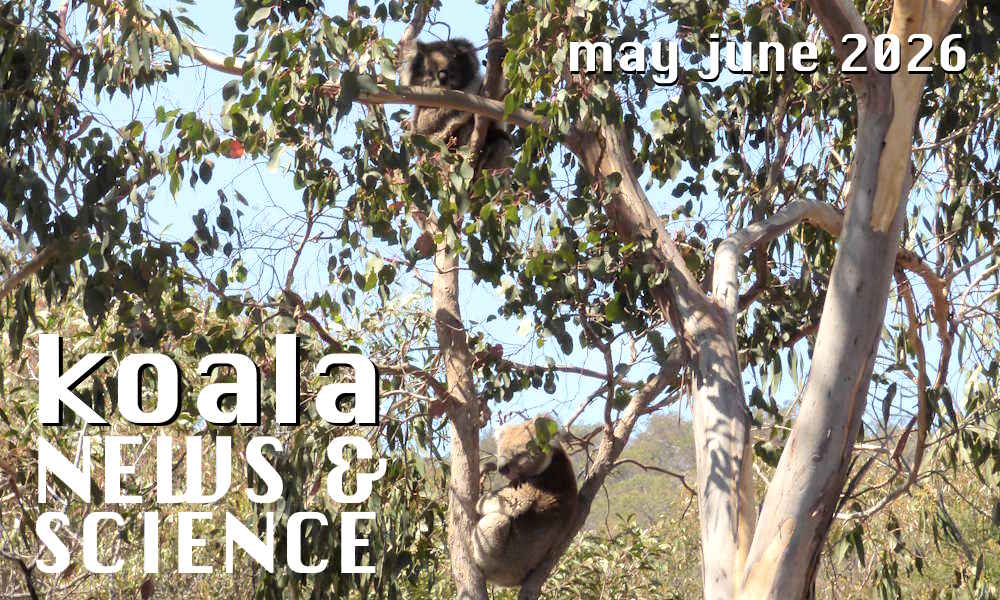
KOALA NEWS & SCIENCE
An informative bi-monthly newsletter about successes & important announcements in koala conservation, and the latest scientific publications about koalas.
May June 2026
Subscribe here: https://mailchi.mp/808fc4af1ee0/koala-news-science
..
National Koala Conference 20 – 22 July 2026, Port Macquarie NSW
A 3 day packed program of speakers, panels and site visits, the second national koala conference will focus on: From challenges to solutions: Advancing koala conservation through innovation.
Attend in person or online. Book tickets, or see program here: https://kca-national-koala-conference.raiselysite.com/
..
Latest Koala Science
..
Brunton, E.A., Hohwieler, K., McDonald, K. and Cristescu, R.H., 2026. Mapping connectivity for conservation of a threatened iconic mammal, the koala: Trends, challenges and opportunities. Ecological Solutions and Evidence, 7(2), p.e70253.
https://besjournals.onlinelibrary.wiley.com/doi/abs/10.1002/2688-8319.70253
Connectivity of wildlife populations is considered a key component of biodiversity conservation and management; therefore, connectivity mapping is increasingly performed for wildlife species worldwide. We systematically reviewed the connectivity literature for an iconic threatened species, the koala (Phascolarctos cinereus). Consistent with global trends in connectivity research, recent koala studies were more likely to assess potential functional connectivity. Yet, in contrast to recent global trends, no koala studies have used realised functional connectivity measures (i.e. incorporating telemetry or genetic data). There was wide variation in variables used (with no two studies utilising the same combination of variables) and analysis techniques, with no standard methods employed to calculate variables used to estimate koala connectivity. Less than a quarter of the studies included data from local koala populations to inform connectivity mapping, with most (71%) having to rely on expert opinion to inform analyses where data was lacking. Only 30% of studies directly validated connectivity outputs with field surveys for current koala presence. Wide variations in koala ecology and behaviour across their broad distribution, difficulties in defining suitable habitat and a lack of available data, remain key challenges to effective connectivity mapping. Practical implication. Realised functional connectivity mapping could facilitate successful conservation management of this threatened species, yet this review indicates that global scientific advances in connectivity mapping are yet to be fully utilised for koalas. There is a risk that the availability of mapping products may provide decision makers with a false sense of confidence when applying these products to koala conservation management and planning. Whereas, in most cases, the supporting fundamental ecological data required for robust connectivity mapping is still lacking.
..
Travouillon, K., Warburton, N.M., Thorn, K.M. and Ryan, H., 2026. New fossil koala (Marsupialia: Phascolarctidae) from the Pleistocene of Western Australia. Royal Society open science, 13(5), p.251572. https://royalsocietypublishing.org/rsos/article/13/5/251572/481580/New-fossil-koala-Marsupialia-Phascolarctidae-from
Koalas are regionally extinct in Western Australia (WA), but their fossils have been known since 1910. Bones were previously reported from several cave deposits in the south-west of WA, Koala Cave in Yanchep and from Madura Cave on the Roe Plain. Due to the similarity of the dentition with the east coast koala (Phascolarctos cinereus), they were traditionally assumed to be the same species. Two complete additional adult skulls were collected in the past 25 years. These skulls, interpreted to belong to a male and female koala, are similar in body size to koalas from Victoria but differ markedly in being relatively much shorter in length and having obvious deeper concavities on the maxilla, below the zygomatic arch. Differences from the eastern species are also apparent in the postcranial skeleton, having less robust joints. Analysis of measurements on the skulls and teeth demonstrates quantitatively that the Western Australian koala is morphologically distinct from its east coast relative and warrants consideration as its own species. It probably went extinct in WA as a result of climate change during the late Pleistocene, which reduced eucalyptus forests to around 5% of their current cover, greatly limiting resources for food and shelter.
..
Levengood, A.L., Hohwieler, K., Powell, D. and Cristescu, R., 2026. Data from: Maximizing the quality of non-invasive samples for conservation genetics using targeted next-generation sequencing: a comparison of fecal DNA preservation methodologies. Dryad, 4.
https://research.usc.edu.au/esploro/outputs/dataset/Data-from-Maximizing-the-quality-of/991234502402621
Non-invasive DNA sampling from feces can provide powerful tools for wildlife research, management, and conservation. However, obtaining high quality and quantity fecal DNA is notoriously problematic, being affected by many different variables. Arguably, the most influential factor within the control of biologists is how samples are collected and stored prior to laboratory analyses. Here, we aimed to compare different fecal DNA preservation methodologies for their performance with a targeted genotyping approach and improve the quality and quantity of DNA extracted to better inform sampling of feces in the field. We assessed the proportion of missing single nucleotide polymorphism (SNP) data resulting from seven different fecal DNA preservation methodologies on fresh koala (Phascolarctos cinereus) scats. DNA was successfully obtained from all preservation methodologies; however, optimal recovery of DNA was obtained via a lysis shaken (i.e., washed) methodology, which provided a yield almost equivalent to that of more invasively sampled, high-quality tissue samples. Our findings suggest there is a significant advantage of using a lysis buffer and washing technique coupled with targeted genotyping from scats. As a robust sampling method underpins successful data analysis, this optimized fecal sampling technique can further enhance our ability to address critical questions in population ecology, conservation genetics, and population management and help implement improved conservation strategies and decision making.
..
Levaggi, K., Mella, V., Shaw, M., Campbell, M. and Herbert, C., 2026. Training Koalas for Syringe Feeding: Factors Influencing Acceptance and Behaviour. Applied Animal Behaviour Science, p.107087. https://www.sciencedirect.com/science/article/pii/S0168159126001784
Positive reinforcement conditioning is widely used in zoological settings to improve animal compliance during routine husbandry and veterinary procedures. While this approach has been well documented in many taxa, its application to marsupials remains poorly studied, despite evidence of strong learning abilities in several species. Koalas (Phascolarctos cinereus) present unique training challenges due to their limited intrinsic drive for continuous mental stimulation associated with their long rest periods and highly selective specialised feeding, limiting the efficacy of primary reinforcers. In captivity, koalas’ maintenance is constrained by the availability and variable quality of Eucalyptus foliage, sometimes requiring dietary supplementation. However, due to their highly specialised diet koalas may not readily recognise nutritional supplements as food, often resulting in the need for manual syringe-feeding. Training koalas to accept syringe-feeding through positive reinforcement could reduce handling stress, improve compliance, and enhance welfare, yet standardised methods remain poorly described. This study investigated whether captive koalas could be conditioned to voluntarily accept syringe-feeding of a commercially available dietary supplement as part of their routine husbandry. The aims were to evaluate the capacity of koalas to learn to accept syringe-feeding training, identify factors which may influence individual variation in learning and assess the practicality of incorporating syringe-feeding conditioning into routine care. Behavioural tolerance of humans was the strongest predictor of training success with more tolerant individuals displaying significantly higher acceptance rates as well as more time engaging with the syringe and reduced aversive behaviour than less tolerant koalas. Differences in overall training success between individuals may therefore be attributable to temperament (baseline tolerance to humans). However, as training progressed, acceptance rates increased in general, indicating improved willingness or learning to accept syringe-feeding and successful ingestion of the nutritional supplement. These results suggest that incorporating structured, repeated training can enhance the effectiveness of syringe-feeding, ensuring koalas voluntarily accept and consume the required nutritional supplement to contribute to energy and dietary targets. Trainer identity also influenced the amount of time koalas spent engaging with the task and acceptance rates, possibly reflecting differences in trainer experience or interaction style. Our results provide preliminary insights that contribute to a broader understanding of marsupial learning and demonstrate the feasibility of conditioning koalas for voluntary participation in supplemental feeding. Variation in individual koala learning rates and trainer differences should be expected and considered when assessing the suitability of implementing syringe-feeding training as a component of koala management in human care.
..
Eddy, S., Boardman, W.S., Stacy, M., Woolford, L., Huizing, X., Turner, R., Beale, C. and Speight, N., 2026. Koala Kyphoscoliosis: Radiographic and CT Features of Abnormal Vertebral Column Curvature in Koalas (Phascolarctos cinereus) of the Mount Lofty Ranges, South Australia. Animals, 16(11), p.1710.
https://www.mdpi.com/2076-2615/16/11/1710
Abnormal vertebral column curvature is sporadically reported in koalas of the Mount Lofty Ranges, South Australia. This study evaluates the imaging features of 23 koalas from the Mount Lofty Ranges presenting with abnormal vertebral column curvature between 2015 and 2023 using digital radiography and computed tomography (CT). All images were evaluated by four reviewers to assess curve morphology, severity and Cobb angles for both scoliosis and kyphosis. For Cobb angle measurement, radiography performed similarly to CT with good agreement as measured by intraclass correlation coefficient (0.835 and 0.825 respectively) and Lin’s concordance correlation coefficient (>0.85). The apex vertebra was always located between T7 and L6. For both scoliosis and kyphosis apex vertebrae, the thoracolumbar region was the most common location (8/22 and 9/19, respectively). For scoliosis, the caudal thoracic and lumbar regions were equally common (7/22 each), whereas for kyphosis, the caudal thoracic region (7/19) was more frequent than the lumbar region (3/19). Vertebral body rotation was a common component particularly in severely affected individuals, in which complex or ‘S’ shaped curves also occurred. Severity ranged from minimal or mild (6/23) to moderate (5/23) and severe (12/23), with simultaneous kyphosis and scoliosis present most frequently (21/23). As a result, the term, kyphoscoliosis is the most appropriate morphological description for abnormal vertebral curvature in koalas and may have pathophysiologic commonalities with human idiopathic scoliosis. This study is the first to describe imaging features of abnormal vertebral column curvature in koalas and evaluate inter-modality and interobserver agreement between radiography and CT.
..
Rundle-Thiele, S., Fechner, D., Mitchell, S. and Seydel, T., 2026. Alliances in action: how stakeholder collaboration enhances public awareness and conservation actions. Journal of Social Marketing, pp.1-16.
https://www.emerald.com/jsocm/article/doi/10.1108/JSOCM-04-2025-0092/1381502
Purpose Empirical evidence to understand mechanisms and conditions that enable lasting transformation in conservation is lacking. Currently listed as endangered, koalas are culturally, economically and environmentally important in Australia. An unaware and indifferent public can unknowingly contribute to koala deaths through inaction. This paper aims to examine the effectiveness of a cross coordinated koala awareness campaign. This paper assesses whether active participation by local governments increases awareness and conservation actions. Design/methodology/approach The field trial provided a quasi-experimental condition enabling an assessment of whether rates of actions taken by members of community members were higher when local government areas were active participants within a stakeholder alliance. Five of the twelve local government areas participated over a 3-year period, in addition to wildlife sanctuaries, community organisations and wide array of NGOs. The outcome evaluation utilised a convenience sample survey of over 2000 Southeast Queensland residents. Findings Respondents from local government areas who actively partnered in the stakeholder alliance were significantly more aware of three koala awareness campaign messages. Respondents who were aware of the koala awareness campaign were significantly more likely to take actions that protect koalas (e.g. slowing down when driving). Social implications The present study demonstrates how efficiencies can be maximised by State and Federal Governments. Implementation of a cross-coordinated communication campaign can increase rates of conservation actions. Furthermore, cross-coordination efforts deliver significant cost savings. Developing new campaigns takes 6–12 months, costing between $US50,000 and $500,000. Implementation of a single campaign across local government areas ensures scarce resources can be allocated to paid media placements which in turn can further increase awareness and rates of conservation action. Originality/value This study contributes novel empirical evidence on the added effect of active local government participation within a stakeholder alliance on public awareness in a large-scale social marketing campaign. This research study focuses on organisational-level engagement, comparing outcomes in regions with and without active alliance involvement. The findings demonstrate that coordinated, cross-sectoral partnerships can enhance campaign reach and effectiveness.
..
Koala Science in brief
..
Pride, J., Shaw, G., Renfree, M.B. and Newman, T.A., 2026. The marsupial imprinted gene MLH1 has retrocopies in three marsupial families. Epigenetics & Chromatin.
https://link.springer.com/content/pdf/10.1186/s13072-026-00684-z_reference.pdf
..
Harwood, S., Burrage, J. and Whisson, D., 2026. Koalas prefer Blue Gum over three other plantation species. Wildlife Research, p.WR26032.
https://connectsci.au/wr/article/53/6/WR26032/273083/Koalas-prefer-blue-gum-over-three-other-plantation
..
Schlagloth, R., Santamaria, F., McEwan, A., Cahir, F., Danaher, M., Cadman, T., Clode, D., Clark, I. and McGinnis, G., 2026. Where does that ladder lead to? Koalas encountering anthropogenic obstacles in an increasingly urbanised habitat. Australian Zoologist, p.AZ26019.
https://connectsci.au/az/article-abstract/doi/10.1071/AZ26019/274478
..
Kotzur, I., Boer, M., Yebra, M. and Moore, B.D., 2026. Monitoring Forest Foliar Moisture Using Sentinel-2 Reflectance and Radiative Transfer Model Inversion in Australia. IEEE Journal of Selected Topics in Applied Earth Observations and Remote Sensing. https://ieeexplore.ieee.org/stamp/stamp.jsp?tp=&arnumber=11569873
..
Ceccarelli¹, M. and Kuo, C.H., 2026. Two-Thumb Robotic Hands Inspired by Koala. Mechanism Design for Robotics: MEDER 2026, p.410. https://books.google.com.au/books?hl=en&lr=&id=rRvuEQAAQBAJ&oi=fnd&pg=PA410&dq=koala&ots=iOkJmcFz0P&sig=6f8EQJPVLPYOCqpPqnxpeav1oyE
..
Previous Koala News & Science here: https://www.wildkoaladay.com.au/koala-news-science/koala-news-science-march-april-2026/
Written by Janine Duffy President, Koala Clancy Foundation.
Please send your important news & publications to president@koalaclancyfoundation.org.au before 29th of each month for possible inclusion.