
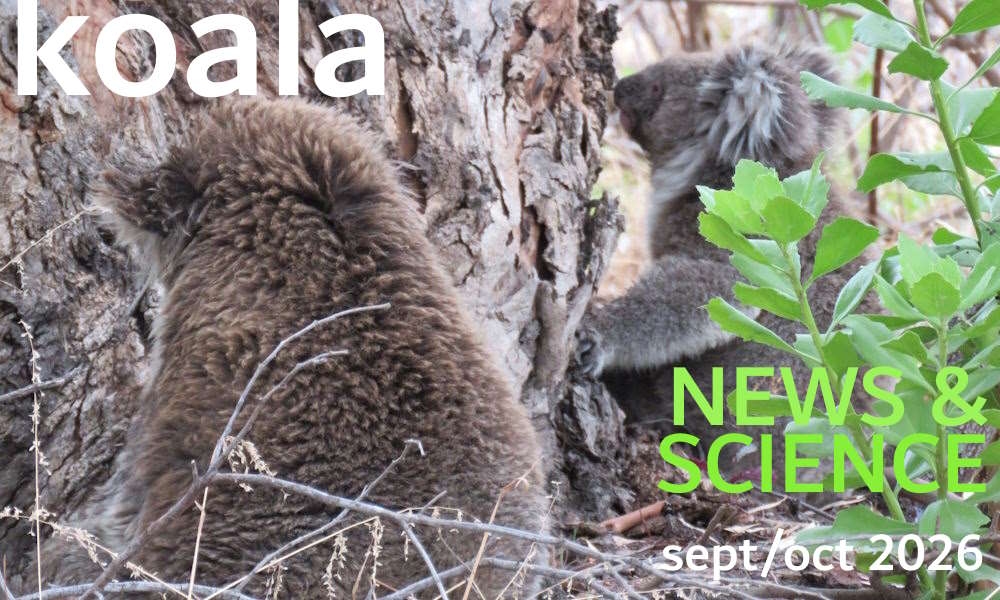
Koala News & Science
An informative bi-monthly newsletter about successes & important announcements in koala conservation, and the latest scientific publications about koalas.
September October 2026
Subscribe here: https://mailchi.mp/808fc4af1ee0/koala-news-science
..
Koala News
Opinion Finally, a Great Koala National Park in NSW, but it was harder than it should have been…
It’s not the Park that was dreamed of, and it’s not the Park that was promised, but it is something. There’s more work to be done, and much to learn from the way this was handled.
https://coffscoast.newsofthearea.com.au/gknp-legislation-still-leaves-unanswered-questions
Good people in the environment movement ended up on different sides of the INFM debate. Each was doing what they believed was right. Debate on principles is healthy and should be encouraged in our sector, it’s what makes us strong. Each group is different, but we all care and do our best.
But I fear that the NSW government manipulated us. They planned and schemed, stalled, increased logging in the footprint, hid documents, lied and obfuscated, and fed us the bad news in measured bites. They kept changing the terms AND the boundaries. Now we have a park without the Forest Bridge, a park without traditional owner consent, a park that’s not all National Park and may allow car rallies through koala habitat.
Most worryingly, in the same month they finally declared the GKNP, the NSW government gave the green light to the state’s largest planet-wrecking mine (Hunter Valley Operations) and announced they will change laws to ensure that MACH Energy’s Mount Pleasant mine expansion goes ahead, despite being ruled invalid by the High Court. These are not unconnected. The NSW government are planning to use the public relations brownie points from the Great Koala National Park to get them past these acts of climate vandalism, and through the next election.
Chris Minns and Penny Sharpe have acted in bad faith on the Great Koala National Park.
Most of all, I’m concerned that once a government succeeds in driving a wedge between environmentalists, they will do it again and again.
Don’t let them divide us. Let’s have our debates internally.
..
Latest Koala Science
..
Sparkes, G.R., Ellis, W.A., FitzGibbon, S.I., Barth, B.J., Crowther, M.S., Fisher, D.O. and Wilson, R.S., 2026. Koala tree-use dynamics vary with tree size and local tree density in a fragmented landscape. Behavioral Ecology, p.arag134.
https://academic.oup.com/beheco/advance-article-abstract/doi/10.1093/beheco/arag134/8976536
Movement between trees is essential for arboreal herbivores in fragmented landscapes, but ground travel can increase energetic costs and predation risk. However, the fine-scale data needed to understand how tree-level decisions shape broader patterns of space use have rarely been available. We combined high-frequency GPS and accelerometry to analyse 92 tree visits from nine free-ranging koalas (Phascolarctos cinereus) monitored over approximately 8-10 days in a fragmented agricultural landscape. We predicted that koala tree use would reflect a balance between the benefits of remaining in a given tree and the costs of moving to another, particularly where movement between trees required ground travel. For each visit, we quantified the temporal dynamics of tree departure, residence time, and within-tree activity in relation to tree size, canopy cover, surrounding tree density, and time of day. Koalas remained in trees about four times longer during the day than at night, were about twice as active during night visits, and were most likely to leave trees before dawn. Koalas also became progressively less likely to leave larger trees as a visit continued, suggesting that larger trees may provide greater value for prolonged occupancy. In contrast, koalas left trees sooner where local tree density was higher, indicating shorter residence times where nearby alternatives were more readily available. In fragmented landscapes, retaining large trees and maintaining locally connected tree cover may therefore help preserve tree-use and movement options for koalas.
..
Martin, J.M., Horan, M., Lane, K., Hare, B., Hutchinson, V., McConnell, T., Roberts, I., Slater, K., Smith‐Maloney, J. and Reside, A.E., 2026. To Drone or Not to Drone in Search of Koalas. Ecological Management & Restoration, 27(3), p.e70068. https://doi.org/10.1111/emr.70068
Effective assessment of koala (Phascolarctos cinereus) populations remains essential for informing conservation management, particularly in complex landscapes. We used drone thermal-imagery and spot assessment technique (SAT) surveys to assess koala occurrence, density, and site use across 37 sites (696.07 ha) within a broader 10,271 ha study area in central Queensland—on the traditional land of the Widi people. Nocturnal drone surveys detected 89 koalas in 26 of the 37 sites (70%), with a mean density of 0.13 ± 0.11 (SE) koalas/ha. Diurnal SAT searches detected koala scats at 33 of 37 sites (89%), with scats found at the base of 16.7% of the 1110 trees searched. Both the drone and SAT surveys indicated moderate koala densities based on the literature. The combination of the two methods gives a robust site-specific koala population estimate and a ground-based activity index, meeting legislative impact assessment criteria. Repeat surveys across large and heterogeneous landscapes allow land managers to monitor the trajectory of this endangered species and inform land use planning and restoration priorities. Furthermore, repeat population and activity surveys directly inform legislative conditional approvals.
..
Hogg, C., Bagot, S., McLennan, E., Schraven, A., Li, A., Silver, L. and Belov, K., 2026. A koala pangenome reveals hidden structural variation with implications for disease and fertility.
https://doi.org/10.21203/rs.3.rs-11081168/v1
Structural variation is likely a major driver of adaptation yet has remained largely unexplored in wildlife genomics with most species represented by a single reference genome. This limitation is especially acute for wide-ranging species, where local adaptation, disease exposure and demographic history can vary dramatically. Here we construct the first marsupial pangenome from 13 long-read koala (Phascolarctos cinereus) genomes spanning the species’ range across eastern Australia. We identify approximately 193,000 SVs and half a gigabase of sequence absent from the current reference genome, revealing extensive unexplored diversity across populations. Within these variants we highlight candidate mechanisms underlying regional differences in disease susceptibility, retroviral biology, and fertility, including a duplication of a chlamydia-inhibiting cathelicidin, loss of trypsin-like genes implicated in viral entry, and a centromere-associated expansion of SUN2-like genes. Across the range, endogenous retroviruses are contributing to ongoing genome evolution. Our findings show that structural variation contributes substantially to functional genomic diversity in koalas and provide a framework for linking genome architecture to phenotypic divergence in threatened wildlife. More broadly, this work demonstrates how pangenomes can uncover adaptive variation that is difficult to detect using short-reads and single-reference approaches.
..
Sommers, C., Hewson, M., Schlagloth, R., George, S. and Morris, J.D.N., 2026. Field Validation of Prospective Koala Habitats on Woppa (Great Keppel Island) to Support Future Indigenous-Led Land Management and Conservation Planning. Wild, 3(3), p.35. https://www.mdpi.com/3042-4526/3/3/35
Koalas (Phascolarctos cinereus) are becoming increasingly vulnerable due to habitat loss, climate-change and other human-related pressures. As a result, finding safe refuges where koalas can survive in the future is an important conservation goal. This preliminary study investigated whether Woppa, an island off the coast of Central Queensland, has food-tree habitats that may be capable of supporting a koala population while contributing to future Indigenous-led conservation planning. Government habitat maps were compared with on-ground vegetation surveys to see how accurately the maps reflected actual tree species distribution on the island. The study also included the perspectives of an authorised Woppaburra Traditional Owner to incorporate Woppaburra perspectives, knowledge and values into the assessment. Results showed that the habitat quality varied across the island, with few areas matching the respective government mapping. Important koala food trees were found in both highly ranked and lower-ranked habitat areas. The perspective provided by the interviewed Woppaburra Traditional Owner highlighted cultural support for considering future conservation actions alongside appropriate Woppaburra governance and further community engagement. This research provides important baseline information to guide future koala conservation, habitat management, and culturally informed land-stewardship on Woppa.
..
Koala Science In Brief
..
McDougall, F.K., Paranagama, K., Boardman, W.S., Wyres, K. and Power, M.L., 2026. Detection of opportunistic bacterial pathogens with intrinsic amoxicillin-and cephalosporin-resistance in wild koala faecal microbiomes. Microbiology, 172(9), p.001773. https://www.microbiologyresearch.org/content/journal/micro/10.1099/mic.0.001773
..
Fatema, K., Bahar, M.M. and Megharaj, M., 2026. Cellulolytic potential of bacteria isolated from Australian marsupial herbivores. Brazilian Journal of Microbiology, 57(1), p.265.
https://link.springer.com/article/10.1007/s42770-026-02090-9
..
Jessop, T.S., Hope, B., Webb, E., Clements, M., Beranek, C. and Le Pla, M., 2026. Addressing stationarity violations in double‐observer drone surveys: A koala case study. Ecological Solutions and Evidence, 7(4), p.e70339.
https://doi.org/10.1002/2688-8319.70339
..
Damyanova, K., Banking on Spermatogonial Stem Cells to Safeguard Australia’s Native Fauna (Doctoral dissertation, Open Research Newcastle).
https://openresearch.newcastle.edu.au/articles/thesis/Banking_on_Spermatogonial_Stem_Cells_to_Safeguard_Australia_s_Native_Fauna/33826711/1
..
Shigemitsu, D., Anetai, S., Anetai, H., Kumaratilake, J., Leigh, C., Tokita, K. and Tojima, S., 2026. Morphological characteristics of the forelimb flexor digitorum muscles and their distinctive innervation pattern in koalas (Phascolarctos cinereus): implications for function and morphogenesis. bioRxiv, pp.2026-09. https://www.biorxiv.org/content/10.64898/2026.09.05.749653.abstract
..
Previous Koala News & Science here: https://www.wildkoaladay.com.au/koala-news-science/koala-news-science-july-august-2026/
Written by Janine Duffy President, Koala Clancy Foundation.
Please send your important news & publications to president@koalaclancyfoundation.org.au before 29th of each month for possible inclusion.