
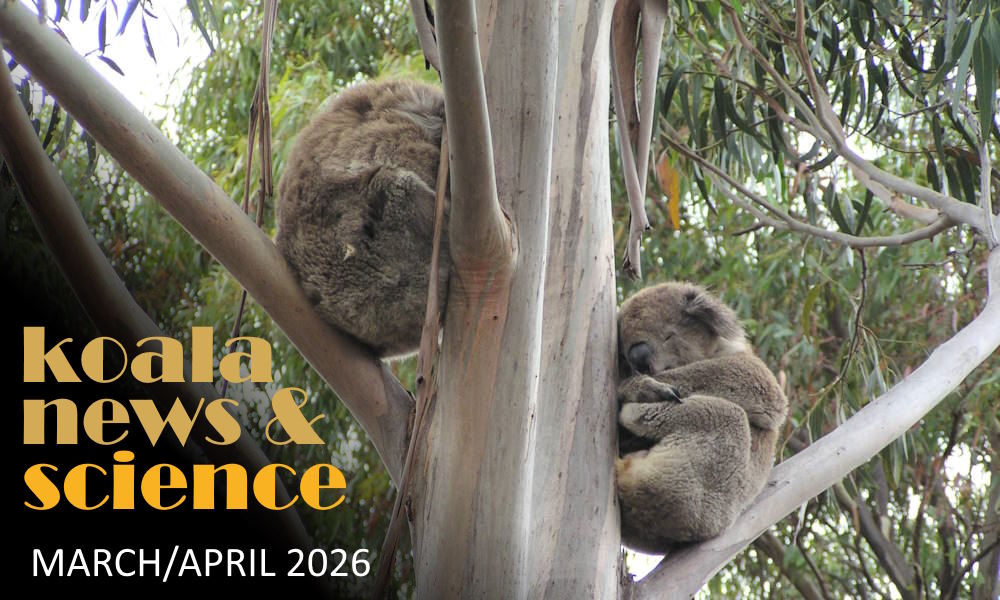
KOALA NEWS & SCIENCE
An informative monthly newsletter about successes & important announcements in koala conservation, and the latest scientific publications about koalas.
March/April 2026
Subscribe here: https://mailchi.mp/808fc4af1ee0/koala-news-science
Wild Koala Day on Sunday 3 May!
It’s our tenth anniversary of Wild Koala Day this year, and a lot has happened since the first Wild Koala Day in 2016.
Check the website for a list of highlights, and some lows, in the last decade. There’s also some resources there you can download to share on the day. https://www.wildkoaladay.com.au/
Events for Wild Koala Day:
Saturday 2 May:
VIC Koala scat collection training day by Western Port Koala Corridor Project, at Pines Flora Reserve https://www.facebook.com/groups/783565743444108/posts/1600051715128836
NSW Midcoast Council Wild Koala Day tree giveaway, Burrell Creek Hall https://www.facebook.com/MidCoastCouncil/posts/-celebrate-wild-koala-day-with-us-at-burrell-creek-hall-visit-our-tree-giveaway-/1357341406427866/
Sunday 3 May
QLD Pine Rivers Koala Care Wild Koala Day public event, St Paul’s School Bald Hills https://www.facebook.com/share/1DHz5BCgHX/
QLD Wild Koala Day 2026 public event at Maroochy Bushland Botanic Gardens by University of Sunshine Coast, Detection Dogs for Conservation, Maroochy https://www.eventbrite.com.au/e/unisc-wild-koala-day-free-family-event-tickets-1987664456897
QLD Koala Action Gympie Region stall at Imbil Market https://shorturl.at/xIOEy
NSW Wild Koala Day community planting By Campbelltown City Council Bushcare, Cook Park Reserve, Ruse https://www.eventbrite.com/e/wild-koala-day-community-planting-tickets-1987099983542
VIC Wild Koala Day – Koala Food Tree Planting Day by Mornington Peninsula Koala Conservation, Balnarring SOLD OUT, other dates available. https://www.eventbrite.com.au/e/wild-koala-day-koala-food-tree-planting-day-balnarring-tickets-1986298100087
VIC Wild Koala Day weeding and wildlife walk by Koala Clancy Foundation, You Yangs area. https://www.koalaclancyfoundation.org.au/event/koala-conservation-day-weeding-and-wildlife-walk-wild-koala-day-2026/
ONLINE Wild Koala Day Q&A with Katrina on livestream https://www.facebook.com/koalagardens
ONLINE Wild Koala Day poetry competition by Koala Gardens at Tuckurimba https://www.facebook.com/koalagardens
Monday 4 May
VIC Koala Clancy Foundation RAFFLE FOR HABITAT draw https://www.koalaclancyfoundation.org.au/raffle/
Wednesday 6 May
ACT Gula habitat transect surveys by Canberra Region Koalas, at McQuoid’s Hill Nature Reserve https://www.facebook.com/groups/825949177536196/posts/3842411075889976
..
Latest Koala Science
..
Ahrens, C.W., Miller, A.D., Silver, L.W., McLennan, E.A., Hogg, C.J. and Weeks, A.R., 2026. Escaping bottlenecks: The demographic path to genetic recovery in koalas (Phascolarctos cinereus). Science, 391(6789), pp.1010-1014. https://doi.org/10.1126/science.adz1430
Population bottlenecks can lead to evolutionary dead ends by eroding genetic diversity and intensifying inbreeding. Although theory predicts possible escape routes, direct observations of this process are rare. Using whole-genome data from 418 koalas, we found that populations with higher genetic diversity harbored the greatest mutational loads and had declining effective population sizes (Ne), whereas historically bottlenecked but recovering populations displayed reduced mutational load, exhibited increasing Ne, and regenerated new, rare variants. We concluded that this pattern was due to rapid demographic expansion, which reshuffled genetic variation through recombination and affected Ne more quickly than it did conventional diversity metrics. Our findings suggest that recovery of bottlenecked populations can occur through rapid demographic growth and that this can reestablish evolutionary potential in threatened populations.
..
Lane, M.R., Youngentob, K.N., Clark, R.G., Skewes, J.D., Moore, B.D. and Marsh, K.J., 2026. Temporal changes in the foliar chemical composition of forest trees after fire. Journal of Ecology, 114(3), p.e70299. https://doi.org/10.1111/1365-2745.70299
Food is essential for animal survival, but wildfire can influence the availability and quality of food resources. However, even in fire-prone regions, we often lack a detailed understanding of how fire alters the nutritional landscape and how plant chemical composition varies over time since fire. In Australian forests, many eucalypts exhibit a key fire adaptation: the ability to resprout epicormically, producing new shoots from aerial stems shortly after fire. Little is known about the nutritional quality of epicormic foliage or how it supports the survival and recovery of endangered arboreal folivores such as the koala (Phascolarctos cinereus) and the greater gliders (Petauroides spp.). This gap in knowledge is particularly urgent to address as wildfires increase in frequency and severity due to anthropogenic climate change.
The aim of this study was to measure how the nutrient and plant secondary metabolite (PSM) concentrations of post-fire epicormic growth changed over 1 year in six eucalypt species known to be browsed by arboreal marsupials. For comparison, we also sampled adult phase foliage from the same species in a nearby unburnt area, and in the burnt landscape where it was available.
Total nitrogen concentrations were higher in epicormic foliage than in adult phase foliage from unburnt areas for all six eucalypt species, and declined over time in four of the six species. The available nitrogen concentration (a measure of the concentration of N liberated by mammalian digestion) was only higher in epicormic foliage for four of the six species, also decreasing over time. Concentrations of formylated phloroglucinol compounds, a type of PSM known to deter feeding by marsupial folivores, were generally higher in epicormic foliage. In contrast, unsubstituted B-ring flavanone concentrations, another class of PSMs, were generally lower in epicormic foliage.
Synthesis. This study shows that fire changes the leaf chemistry of a critical food resource for arboreal folivores. This could conceivably influence diet selection and quality after fire by altering trade-offs between nutrient acquisition and plant defence. This has implications for our understanding of the habitat requirements for threatened folivores, since the tree species normally associated with their diet may differ in quality in burnt and unburnt landscapes.
..
Goh, K.R., Anthoniel, N.B., Stait-Gardner, T., Kurniawan, N.D. and Keller, M.D., 2026. Description of the koala (Phascolarctos cinereus) brain based on magnetic resonance images. Frontiers in Neurology, 17, p.1733030. https://pmc.ncbi.nlm.nih.gov/articles/PMC13067875/ https://doi.org/10.3389/fneur.2026.1733030
Introduction Australia’s native fauna is unique through millions of years of isolated evolution resulting in a significant divergence of marsupial brain anatomy, and thus neural pathways, from eutherian mammals. This study provides a morphometric description of a mature female koala (Phascolarctos cinereus) through segmentation of high-resolution magnetic resonance images. As the availability of brain specimens of the endangered koala is scarce, brain segmentation has been performed on a single specimen. Methods The brain of a naturally deceased koala was removed and fixed in 10% neutral buffered formaldehyde (pH 7.0). The MRI was acquired on a 9.4 T Bruker Biospec MR system with Paravision 7.0 software, using a 3D multigradient echo sequence, with TR/TE = 70 msec/ (8 echoes 4–32 msec), a field of view = 7.0 × 6.4 × 4.0 cm3. AMIRA post image processing software was used to create three-dimensional volume reconstruction of different brain structures, allowing for the calculation of their volumes. Results The koala brain is lissencephalic and has a volume of 15720.98 mm3. It was found that the olfactory bulbs of the koala were 418 mm3 or 2.66% of the total brain volume (tbv). The cerebral hemispheres were 9336.92 mm3 (59.39% of the tbv). The interhemispheric connections were 148 mm3 (0.94% of tbv). The combined volume of the anterior commissure and fasciculus aberrans, which is specific to marsupials, has also been labeled and segmented. The ventricular system was 172 mm3 (1.09% of tbv). The brainstem was 1874 mm3 (11.92% of tbv). The cerebellum was 2304.69 mm3 (14.66% of tbv). Conclusion This study can be used as a basis for clinical imaging of koalas and as baseline data for future research into brain development of koalas and other marsupials.
..
Harwood, S.E. and Whisson, D.A., 2026. Translocate or manage onsite? Similar welfare outcomes for koalas during plantation harvest. Forest Ecology and Management, 612, p.123774. https://doi.org/10.1016/j.foreco.2026.123774
Plantation forests are expanding globally to meet resource needs. However, conflict between plantation management and wildlife can arise at all stages of plantation production. In southern Australia, koalas (Phascolarctos cinereus) are particularly at risk of injury, death or displacement during harvest of Blue Gum (Eucalyptus globulus) plantations. Under current regulations, koalas are located and the trees they are sitting in retained while occupied, to minimise risk of koalas being injured by harvest machinery. As harvest progresses, koalas either remain in the retained trees or relocate to alternative habitat. We aimed to evaluate whether short-distance translocation improves the welfare outcomes for koalas during harvest operations. We compared the movement, survival and health of 22 koalas remaining in plantations (harvest koalas) and 21 koalas translocated into nearby native forest (translocated koalas). Each koala was fitted with a VHF/GPS collar and tracked for 3–5 months. Translocated koalas moved farther from their release location than harvest koalas that either stayed in unharvested plantation trees or moved to adjacent habitat. However, daily movement distance was similar for both groups. Change in body mass was also similar. Three translocated and two harvest adult koalas died during the study. Two of four translocated dependent young may have been abandoned, whereas all four dependent young in the harvest group survived. Ultimately, translocation did not improve the welfare outcomes for koalas within plantations under harvest relative to existing management. However, translocation may be preferable in plantations with limited availability of and connectivity to alternative habitat.
..
Mohottige, M.W.J., Juhász, A., Peel, E., Nye-Wood, M.G., Farquharson, K.A., Khedr, T., Belov, K., Hogg, C.J. and Colgrave, M.L., 2026. Lactation-stage specific protein shifts in koala milk mirror the joey’s growth needs. International Journal of Biological Macromolecules, p.151640. https://doi.org/10.1016/j.ijbiomac.2026.151640
Koalas (Phascolarctos cinereus) give birth to highly altricial young that rely on maternal milk for nutritional support and immune protection in the first year of life. This study applied proteomics to analyse stage-specific shifts in the koala milk proteome across early-, mid-, and late-lactation. Proteins were extracted from seven samples and analysed using liquid chromatography-tandem mass spectrometry. Quantitative profiling identified 874, 1220, and 498 proteins in early-, mid- and late-lactation stages, respectively. The most abundant proteins—including β-lactoglobulin, caseins, clusterin, trichosurin, albumin and lactotransferrin—were consistently detected across all stages, reflecting crucial roles in nutrition, immune function, and detoxification. Protein–protein interaction analyses revealed functionally important protein clusters associated with energy metabolism, translation, protein transportation, and these clusters exhibited shifts in abundance that align with the developmental and metabolic demands of the joey. Gene set variation analysis revealed stage-dependent regulation of immune pathway proteins, supporting foundational immune development in early-lactation, heightened neuroimmune protection in mid-lactation, and increased immune competence in late-lactation. These findings provide comprehensive insight into the dynamic adaptation of koala milk composition to joey development and may inform the design of nutritionally and immunologically optimised milk replacers for koala conservation and rehabilitation.
..
Pfeiffer, C.N., McMeekin, B., Skerratt, L.F. and Ploeg, R.J., 2026. Retrospective Analysis of Triage and Hospitalisation Records for Bushfire-Affected Koalas (Phascolarctos cinereus) and Other Wildlife Species from Victoria, Australia, 2019–2020. Animals, 16(6), p.944. https://doi.org/10.3390/ani16060944
Following bushfires (also known as wildfires), impacted free-living wildlife may be captured and presented for veterinary assessment. This study was an in-depth investigation of the records of veterinary assessment and treatment of 259 animals in Victoria, Australia, impacted by bushfire in late 2019 and early 2020. The animals assessed included 35 different species, most commonly koalas. Further evaluation of the 6-month post-rescue outcomes for koalas presented for assessment was undertaken to understand the likelihood of survival for koalas with health impacts of fire exposure including injuries. The koalas least likely to survive were older koalas, koalas in poor body condition, and those rescued and evaluated in the first days after the fire. Two thirds of the koalas had burn injuries, and in addition to age and body condition, those with more severe burns and burns to many toes were least likely to survive. These findings can support veterinarians in understanding the likely medical outcomes for bushfire-affected koalas in the future and thus also assist in the appropriate allocation of treatment and rehabilitation resources to those animals most likely to recover.
..
Wallis, K., Phillips, S. and Lane, A., 2026. Using species relevant timeframes to partition, prioritise and monitor vehicle-strike blackspots: a case study using the Koala Phascolarctos cinereus in Lismore, New South Wales. Australian Zoologist, 45(1), p.AZ25059. https://doi.org/10.1071/AZ25059
Vehicle-strike accounts for the death of millions of animals annually and can cause damage to property and humans. Mitigating the potential for vehicle-strike is expensive. Therefore, objectively identifying and prioritising areas for mitigation works is important. We partitioned roads in Lismore, New South Wales into 1-km segments and overlaid this with generationally-partitioned vehicle-strike records for the threatened Koala Phascolarctos cinereus. Extending generational timeframes to accommodate under-reporting in areas of low observer density, a K-distance plot was used to identify road segments with the greatest vehicle-strike potential, whereafter we used the 95% confidence interval derived from averaging the Euclidean distances between the five nearest records to identify vehicle-strike clusters. Output was standardised into the number of koalas struck by vehicles per kilometre per generation, which we then ranked to identify road segments where the potential for ongoing vehicle-strike was greatest. We conclude that techniques of cluster analyses informed by recognised conservation criteria allow roads to be ranked by severity of impact and can therefore guide management actions that maximise financial and/or ecological return, as well as providing important baseline metrics for monitoring purposes.
..
Koala Science in Brief
..
Johnston, S., 2026. Koala Conservation: The Utility of Art and Genome Banking. Reproductive Sciences in Animal Conservation, pp.535-552. https://doi.org/10.1007/978-3-031-87707-0_16
..
Donnelly, L., Kjeldsen, S., Lott, M., Leigh, K., Field, M., Cooke, I., Wright, B. and Zenger, K., 2026. An Integrated SNP Genotyping Assay for Genomic Monitoring of the Koala (Phascolarctos cinereus). https://sciforum.net/paper/view/29602
..
Duong, H.Q., Wong, J.S., Doyle, M., Phillips, S., Pollak, N., Timms, P. and Jelocnik, M., 2026. Current status and future directions of Chlamydia pecorum research: a scoping review (2010–2025). Frontiers in Veterinary Science, 13, p.1799591. https://doi.org/10.3389/fvets.2026.1799591
..
Previous Koala News & Science here: https://www.wildkoaladay.com.au/koala-news-science/jan-feb-2026/
Written by Janine Duffy President, Koala Clancy Foundation.
with support from Cheryl Egan, Organiser, Wild Koala Day.
Please send your important news & publications to president@koalaclancyfoundation.org.au before 29th of each month for possible inclusion.