
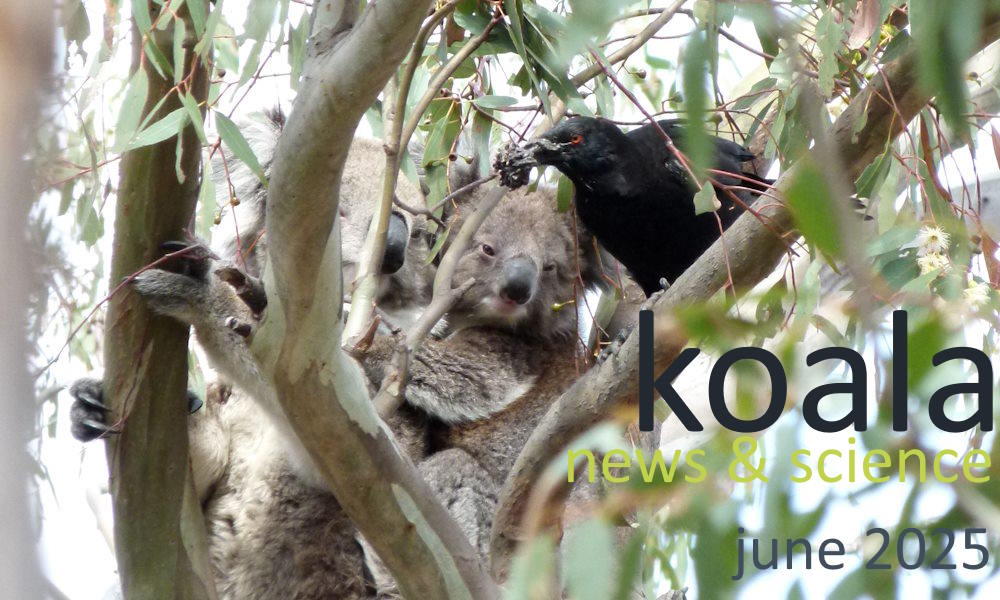
KOALA NEWS & SCIENCE
An informative monthly newsletter about successes & important announcements in koala conservation, and the latest scientific publications about koalas.
June 2025
Subscribe here: https://mailchi.mp/808fc4af1ee0/koala-news-science
Another year of delays put Great Koala National Park on the backburner NSW
Nearly 3 years into the election term in which it promised a GKNP, and the NSW government hasn’t budgeted for the park to go ahead in this financial year. Boundaries still haven’t been approved, though promised in Dec 2024. The next state election will be 13 March 2027, which leaves little time for the GKNP in this election term. Expect NSW Labor to ‘recycle’ this promise again next election.
https://www.echo.net.au/2025/06/minns-leaves-koalas-out-in-the-cold-as-logging-in-great-koala-national-park-continues/
https://www.theguardian.com/australia-news/2025/jun/19/nsw-budget-unlikely-to-allocate-extra-funding-for-long-promised-great-koala-national-park
https://www.greenleft.org.au/content/nsw-labor-again-delays-great-koala-national-park
https://wilderness.org.au/news-events/minns-budget-condemns-koala-park-to-further-logging
https://bobbrown.org.au/minns-is-logging-koala-habitat-not-delivering-promised-protection/
Congratulations to Bangalow Koalas on their 450,000th tree planted!
The amazing team are really close to meeting their massive goal of 500,000 trees by end 2025!
https://gofund.me/9fbd5579
https://www.echo.net.au/2025/05/bangalow-koalas-celebrates-over-450000-trees-planted-across-northern-rivers/
https://www.bangalowkoalas.com.au/
Nature Media Centre seeks expert spokespeople
A new platform has launched for journalists to find expert commentary on nature and the biodiversity crisis. Experts willing to speak to media are invited to nominate, and training is offered. The database is a joint project of the Biodiversity Council, Pew Charitable Trusts and Australian Land Conservation Alliance.
https://naturemediacentre.org.au/
..
Latest Koala Science
..
Akter, L., Hashem, M.A., Kayesh, M.E.H., Rakib, T.M., Rashid, M.H.O., Maetani, F. and Kohara, K.T., 2025. Elevated oncogene expressions in koala infected with multiple koala retrovirus subtypes: a preliminary study. Virus Genes, pp.1-5. https://link.springer.com/article/10.1007/s11262-025-02169-9
Koala retrovirus (KoRV) causes multiple disease phenotypes in koalas, including carcinogenesis. The study aimed to assess oncogene expression in spleen tissues from ten deceased koalas coinfected with different subtypes and peripheral blood mononuclear cells (PBMCs) from two subclinically coinfected koalas with KoRV-A and KoRV-B. Initially, KoRV subtyping involved amplifying endogenous KoRV-A, and exogenous KoRV-B, -C specific env gene fragments, followed by sequencing. Using quantitative real-time polymerase chain reaction (RT-qPCR), we examined five oncogenes (BCL2, BAX, BCL2L1, BCL3, and MYC) in spleen and PBMCs from dead and alive koalas coinfected with multiple KoRV subtypes, respectively. Significant (p < 0.05) increases in BCL2 and BAX oncogene expression were observed in deceased koalas that were coinfected with multiple KoRV subtypes compared with healthy koalas. Thus, this study highlights a potential link between KoRV subtype infections, oncogene expression, and koala diseases.
..
Schlagloth, R., Danaher, M., Hewson, M. and Santamaria, F., 2025. Koala Conservation in Central Queensland: Anecdotes, Stories and Perspectives from the Landholders and Wider Community. https://www.preprints.org/manuscript/202506.1342/v1
Central Queensland (CQ) is characterised by low-density koala populations, primarily inhabiting large cattle properties. We were interested in better understanding what encounters various stakeholders (mainly landholders) have had with koalas across CQ in order to find out more about the koalas’ conservation needs. Therefore, we based our research on obtaining substantial qualitative interview data and corroborating that data with some historical and scientific literature. This essentially reflects the hybrid approach we took in researching and writing the paper, that reveals a unique picture of relationships between people and koalas in Central Queensland. This study investigates the status and trends of koalas in this region through the voices of local stakeholders. Semi-structured interviews were conducted with 88 landholders, community members and conservation officers across CQ. An analysis of the interview data revealed emergent topics that provide insight into the challenges, opportunities and conservation efforts related to koala management in the region. This research offers a nuanced understanding of the complex relationships between koalas, land use, and local communities, informing effective conservation strategies for this iconic species and giving hope for the conservation of the species in this region through stakeholder collaboration
..
Ryan, S.A., Southwell, D.M., Beranek, C.T., Clulow, J., Jordan, N.R. and Witt, R.R., 2025. Estimating the landscape-scale abundance of an arboreal folivore using thermal imaging drones and binomial N-mixture modelling. Biological Conservation, p.111207. https://doi.org/10.1016/j.biocon.2025.111207
Estimating the abundance of wildlife populations at a landscape-scale is vital for conservation, but is often hampered by survey costs, data processing and imperfect detection. In this study, we developed a framework that combines a protocol for validating nocturnal thermal drone detections in real-time with N-mixture modelling to estimate the landscape-scale abundance of arboreal folivores. As a case study, we estimated the abundance of koalas (Phascolarctos cinereus) across seven reserves (673 km2) in New South Wales, Australia. We conducted thermal drone surveys of 208, 25-ha sites stratified across vegetation type and fire history, on average, three times over consecutive nights (range 1–12 repeats), between 18:00–04:00 h (May to September). All koala detections were validated by field personnel or in real-time with drones equipped with a thermal camera and searchlight. Koalas were detected on 245 occasions. We fitted N-mixture models to validated repeat count data to quantify the effect of site and observation variables on abundance and detectability. Using our top set of competing models, we estimated that 4357 koalas (95 % CI = 2319–8307) occupy the seven reserves, with a mean detection probability of 0.22 (95 % CI = 0.15–0.31) over all survey occasions. We found detection probability decreased with increases in relative humidity and temperature. Koala abundance was negatively associated with fire severity, elevation, tree height and soil clay content, and positively associated with available water content, forest cover and soil organic carbon. Our framework, which combines real-time field validated drone data while accounting for imperfect detection, improves the accuracy of abundance estimates for arboreal folivores across large-scales
..
Gillespie, G.R., Gallahar, N., McIlwee, A.P., Hope, B.D., Webb, E.B., Clements, M., Gama, V.F., Casley, M. and Jessop, T.S., 2025. Initial evaluation of a state-wide multi-method survey to estimate koala occupancy and abundance. Ecological Indicators, 176, p.113654. https://doi.org/10.1016/j.ecolind.2025.113654
Knowledge of species distribution and abundance is crucial for effective threatened species management and conservation but is rarely obtained from purpose-built large-scale surveys. The koala (Phascolarctos cinereus) is a nationally threatened species; however, its current distribution is poorly known, and uncertainty has surrounded the most suitable methods to address this at large spatial scales. To implement a state-wide koala survey in New South Wales (NSW), Australia, we sought to address this issue by evaluating and minimising trade-offs between the number of survey sites and site-specific survey effort using a multi-method survey approach. Here, we evaluate the comparative efficacy of three koala survey methods- diurnal transects, drones, and passive acoustic recorders (acoustic recorders) implemented across a wide range of habitats in NSW. We evaluated how these methods, individually and combined, influenced koala detection, occupancy, and relative abundance-related performance criteria to optimise the state-wide koala survey. Under the deployed survey effort, acoustic recorders performed optimally for assessing occupancy, achieving high detection of koalas and avoiding false absences within sites with high certainty (P* ≥ 0.99). To achieve similar performance, drone surveys and diurnal transects required survey effort (and cost) to be increased 19 and 206-fold, respectively. Due to considerable overlap in within-site detection between acoustic recorders and drones and the poor performance of diurnal transects, there is little advantage to using these methods concurrently to estimate koala occupancy. However, drone surveys were highly effective at estimating relative abundance of koalas compared to diurnal transects. Overall, the combined use of acoustic recorders and drones is highly advantageous because, where drones fail to detect koalas, acoustic recorder detections help eliminate false site absences, enhancing the precision of abundance estimates. Their combined use enables interoperability with other survey programs, fostering comparison and standardisation of important koala population measures. Ongoing optimising of koala survey and monitoring methods will improve the capacity to provide important insights for koala management and conservation.
..
Koala Science In Brief
..
Moses, W.B., 2025. Femoral fracture repair in an adult female koala (Phascolarctos cinereus). Veterinary Record Case Reports, p.e70119. https://doi.org/10.1002/vrc2.70119
..
Strickland, K.R., Jelocnik, M., Price, E.P. and Sarovich, D.S., 2025. Prevalence of Pseudomonas aeruginosa in Australian wild birds, native wildlife, livestock and domestic animals. bioRxiv, pp.2025-06. https://doi.org/10.1101/2025.06.23.661201
..
Previous Koala News & Science here: https://www.wildkoaladay.com.au/koala-news-science/koala-news-science-may-2025/
Written by Janine Duffy President, Koala Clancy Foundation.
with support from Cheryl Egan, Organiser, Wild Koala Day.
Please send your positive, important news & publications to president@koalaclancyfoundation.org.au before 29th of each month for possible inclusion.