
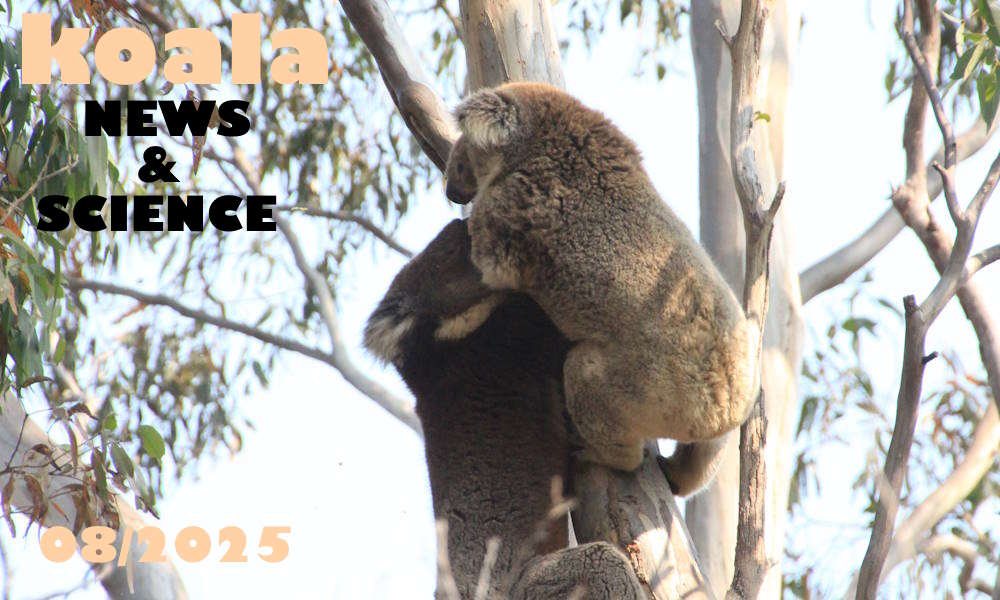
KOALA NEWS & SCIENCE
An informative monthly newsletter about successes & important announcements in koala conservation, and the latest scientific publications about koalas.
August 2025
Subscribe here: https://mailchi.mp/808fc4af1ee0/koala-news-science
Great Koala National Park…. maybe.
Jubilation this week as the GKNP was announced, but…..
- The park has been encumbered with some dirty carbon baggage.
- That baggage will likely threaten the park’s passage through parliament. (When that finally happens, which is 1 to 1.5 years away)
In a sneaky move, the Minns government have tied the park to an unpopular and dubious carbon credit scheme: the IFNM Method.
Pure and unencumbered, the park bill should pass both houses of the parliament easily. Minns has a clear majority in the lower house, and thanks to environment groups, the park has general minor party & independent support in the upper house. (I say general, because the legislation hasn’t been drafted yet, and until it is there’s nothing to support).
But with the dirty carbon baggage, the bill will have opposition, and rightly so.
Environment groups campaigned hard and long for a pure GKNP, and won public support. You didn’t do all that work to pollute this beautiful, pure park with a dirty carbon scheme.
There’s still time to celebrate, and distance yourself from the dirty carbon IFNM. Some already have:
Bob Brown Foundation: https://bobbrown.org.au/great-koala-national-park-announcement-is-welcome-and-must-be-followed-by-ending-native-forest-logging/
EDO: https://www.edo.org.au/2025/09/09/great-koala-national-park-one-step-closer/
Dr Christine Hoskings in The Conversation: https://theconversation.com/koalas-are-running-out-of-time-will-a-140-million-national-park-save-them-264789
..
Latest Koala Science:
..
Simpson, S.J., Higgins, D.P., Timms, P., Kidd, A., Crowther, M.S., Mella, V.S., Phillips, S. and Krockenberger, M.B., 2025. Evaluation of Chlamydia pecorum major outer membrane protein vaccine a management tool in wild koala (Phascolarctos cinereus) populations. Scientific Reports, 15(1), p.30601. https://www.nature.com/articles/s41598-025-13296-6
Chlamydiosis is a significant disease affecting Eastern Australian koalas (Phascolarctos cinereus), contributing to the decline of some koala populations, necessitating investigations into appropriate management strategies to address chlamydiosis in wild koala populations. The aim of this study was to investigate the effect of a Chlamydia pecorum recombinant Major Outer Membrane Protein (rMOMP) vaccine as a potential strategy for managing chlamydiosis at a population level. This study comprised a blinded, randomised placebo-controlled trial, encompassing different koala populations where chlamydiosis is having differing effects. Wild koalas were recruited into a vaccination or a placebo treatment group and followed for 12 months, with recapture and resampling at 2, 6 and 12 months post vaccination. Vaccination stimulated a significant plasma anti-MOMP IgG response and greater IL-17 and TNFα mRNA fold change from rMOMP stimulated leukocytes, however, did not boost pre-existing immune responses, from natural infection, in koalas. The observed immunological stimulation did not translate to any effect on chlamydiosis or chlamydial shedding in our study populations. These findings highlight the necessity of improving our understanding of what constitutes a protective immune response in koalas to guide the development of a more effective vaccine. This study evaluated the estimated effect of vaccination necessary to achieve management outcomes predicted by modelling studies. It is possible that vaccination has a more modest effect and could benefit koala populations with a lower disease prevalence or be useful in conjunction with additional management strategies.
..
McDougall, F.K., Funnell, O., McLelland, J.M., Flanagan, C., Govendir, M., Stoeckeler, F., Smith, I. and Power, M.L., 2025. Systemic antibiotic use in fire‐affected koalas (Phascolarctos cinereus) admitted to two wildlife treatment facilities during the 2019–2020 wildfires. Australian Veterinary Journal, 103(8), pp.475-486. https://doi.org/10.1111/avj.70006
Antimicrobial resistance (AMR) is a global health threat for people and animals, including wildlife. The overuse and misuse of antimicrobials continues to fuel the spread of AMR. We performed a retrospective analysis of systemic antibiotic administration in fire-affected koalas admitted to two wildlife treatment facilities during the catastrophic Australian wildfires in 2019–2020, to assess the practice of antimicrobial stewardship during a wildlife emergency. Triage and treatment records were obtained for fire-affected koalas (n = 355) admitted to two facilities during the wildfires. Analyses showed that 40.3% of koalas at Facility A and 35.0% of koalas at Facility B received systemic antibiotics. The majority of antibiotics (63.9%, comprising multiple types of beta-lactams) administered to koalas at Facility A were prophylactic treatments in koalas with noninfected moderate to severe cutaneous burn wounds. The majority of antibiotics (75.0%, comprising chloramphenicol and enrofloxacin) administered to koalas at Facility B were chlamydial disease treatments. Overall, 29.4% of all antibiotic treatments (predominantly beta-lactams and enrofloxacin) were administered for recorded clinical infections. Where koala-specific guidelines and protocols for treating burn wounds were not available, there was an overuse of systemic antibiotics and frequently sub-optimal antibiotic stewardship in burnt koalas during the 2019–2020 wildfire emergency response. Best practice antibiotic prescribing was also not always feasible due to a shortage of first-choice antibiotics (e.g., injectable chloramphenicol for chlamydial disease). This study highlights the importance of preparedness for future wildfire events and identifies a need for equipping veterinarians with guidelines for treating fire-affected koalas during emergency situations. Additional education, guidance and resources are required to enable appropriate antimicrobial stewardship by responding veterinarians during wildlife emergencies.
..
Bowerman, K.L., Soo, R.M., Chaumeil, P.A., Blyton, M.D., Sørensen, M., Gunbilig, D., Malig, M., Islam, M., Zaugg, J., Wood, D.L. and Liachko, I., 2025. A molecular inventory of the faecal microbiomes of 23 marsupial species. bioRxiv, pp.2025-08. https://www.biorxiv.org/content/10.1101/2025.08.31.672981.abstract
Despite the recent expansion of culture-independent analyses of animal faecal microbiomes, many lineages remain understudied. Marsupials represent one such group, where despite their iconic status, direct sequencing-based analyses remain limited. Here we present a metagenomic and metabolomic exploration of the faecal microbiomes of 23 Diprotodontia marsupials, producing a reference set of 3,868 prokaryotic and 12,142 viral metagenome-assembled genomes, the majority (>80%) of which represent novel species. As with other animals, host phylogeny is the primary driver of microbiome composition, including distinct profiles for two eucalyptus folivore specialists (koalas and southern greater gliders), suggesting independent solutions to this challenging diet. Expansion of several bacterial and viral lineages were observed in these and other marsupial hosts that may provide adaptive benefits. Antimicrobial resistance genes were significantly more prevalent in captive than wild animals likely reflecting human interaction. This molecular dataset contributes to our ongoing understanding of animal faecal microbiomes.
..
Koala Science In Brief:
..
Jayachandiran, S., Suresh, R. and Dhamodharan, R., 2025. Comparative and phylogenomic analysis of Chlamydia pneumoniae reveals unique carbohydrate active enzyme family (GT5) among respiratory isolates. Infection, Genetics and Evolution, p.105813. https://doi.org/10.1016/j.meegid.2025.105813
Orlando, C., Montague-Drake, R., Turbill, J., McIlwee, A. and Crowther, M., Using a State Vegetation Type map to predict legal koala habitat at large scale A case study in the Mid North Coast Region of NSW. Wildlife Research. https://www.publish.csiro.au/WR/justaccepted/WR24188
..
Previous Koala News & Science here: https://www.wildkoaladay.com.au/koala-news-science/koala-news-science-july-2025/
Written by Janine Duffy President, Koala Clancy Foundation.
with support from Cheryl Egan, Organiser, Wild Koala Day.
Please send your important news & publications to president@koalaclancyfoundation.org.au before 29th of each month for possible inclusion.